Reading Results of Univariate Analyses of Covariance
One-mode ANCOVA in SPSS Statistics
Introduction
The one-way ANCOVA (analysis of covariance) tin be thought of as an extension of the one-way ANOVA to comprise a covariate. Similar the one-way ANOVA, the 1-way ANCOVA is used to determine whether at that place are any significant differences between two or more independent (unrelated) groups on a dependent variable. Yet, whereas the ANOVA looks for differences in the grouping ways, the ANCOVA looks for differences in adjusted ways (i.due east., adjusted for the covariate). As such, compared to the 1-mode ANOVA, the one-way ANCOVA has the additional benefit of allowing y'all to "statistically command" for a third variable (sometimes known as a "confounding variable"), which you believe will bear on your results. This tertiary variable that could be confounding your results is called the covariate and you lot include information technology in your 1-way ANCOVA analysis.
Note: You can have more than one covariate and although covariates are traditionally measured on a continuous calibration, they tin can also be categorical. However, when the covariates are categorical, the analysis is not oft called ANCOVA. In addition, the "one-manner" part of one-way ANCOVA refers to the number of independent variables. If you have two contained variables rather than one, you could run a two-way ANCOVA.
If you are familiar with the 1-way ANCOVA, you lot tin can skip to the Assumptions department. On the other hand, if you are not familiar with the one-mode ANCOVA, the instance beneath should assistance provide some clarity.
Researchers wanted to investigate the effect of three unlike types of practice intervention on systolic claret pressure. To do this, they recruited sixty participants to their study. They randomly allocated 20 participants to each of three interventions: a "low-intensity exercise intervention", a "moderate-intensity exercise intervention" and a "high-intensity exercise intervention". The practise in all interventions burned the same number of calories. Each participant had their "systolic blood pressure" measured before the intervention and immediately after the intervention. The researcher wanted to know if the different exercise interventions had unlike furnishings on systolic blood force per unit area. To answer this question, the researchers wanted to determine whether at that place were any differences in mean systolic claret pressure level after the exercise interventions (i.eastward., whether mail-intervention mean systolic claret pressure different betwixt the dissimilar interventions). However, the researchers expected that the impact of the 3 different practise interventions on mean systolic claret pressure would be afflicted by the participants' starting systolic blood pressure (i.e., their systolic blood pressure level before the interventions). To command the post-intervention systolic blood pressure for the differences in pre-intervention systolic blood pressure level, you can run a ane-way ANCOVA with pre-intervention systolic blood pressure level as the covariate, intervention as the independent variable and post-intervention systolic blood pressure as the dependent variable. If you detect a statistically pregnant departure between interventions, you can follow up a one-mode ANCOVA with a mail service hoc test to determine which specific practise interventions differed in terms of their effect on systolic blood pressure (east.thou., whether the high-intensity exercise intervention had a greater consequence on systolic blood pressure than the low-intensity exercise intervention).
This "quick start" guide shows yous how to behave out a 1-way ANCOVA (with one covariate) using SPSS Statistics, as well as interpret and written report the results from this test. Since the ane-way ANCOVA is frequently followed upwards with a mail hoc test, we too show you how to carry out a postal service hoc exam using SPSS Statistics. However, before we innovate yous to this procedure, y'all need to understand the different assumptions that your data must encounter in order for a one-way ANCOVA to give you a valid outcome. We discuss these assumptions next.
SPSS Statistics
Assumptions
When you choose to analyse your data using a one-way ANCOVA, role of the process involves checking to make sure that the data yous want to analyse can actually be analysed using a one-mode ANCOVA. You need to do this because it is only appropriate to use a one-fashion ANCOVA if your information "passes" ix assumptions that are required for a one-mode ANCOVA to give you a valid result. In practise, checking for these 9 assumptions but adds a trivial scrap more time to your analysis, requiring you to click a few more buttons in SPSS Statistics when performing your analysis, equally well as think a petty bit more about your information, only information technology is not a difficult task.
Before we introduce you to these nine assumptions, do not be surprised if, when analysing your ain data using SPSS Statistics, 1 or more of these assumptions is violated (i.eastward., is non met). This is not uncommon when working with existent-world data rather than textbook examples, which ofttimes only show you how to carry out a i-way ANCOVA when everything goes well! Nonetheless, don't worry. Even when your information fails certain assumptions, there is oftentimes a solution to overcome this. First, let's take a look at these nine assumptions:
- Supposition #i: Your dependent variable and covariate variable(s) should be measured on a continuous scale (i.e., they are measured at the interval or ratio level). Examples of variables that meet this criterion include revision time (measured in hours), intelligence (measured using IQ score), exam performance (measured from 0 to 100), weight (measured in kg), and then forth. You tin can acquire more about continuous variables in our article: Types of Variable. As stated earlier, you can have categorical covariates (e.g., a categorical variables such as "gender", which has two categories: "males" and "females"), merely the assay is non ordinarily referred to as an ANCOVA in this state of affairs.
- Assumption #2: Your contained variable should consist of two or more chiselled, independent groups. Example independent variables that meet this criterion include gender (eastward.one thousand., 2 groups: male and female), ethnicity (e.thou., three groups: Caucasian, African American and Hispanic), physical activity level (e.thousand., iv groups: sedentary, low, moderate and high), profession (east.one thousand., five groups: surgeon, doctor, nurse, dentist, therapist), and so along.
- Assumption #3: You should have independence of observations, which means that there is no relationship between the observations in each group or between the groups themselves. For case, there must be dissimilar participants in each group with no participant being in more than one group. This is more of a written report blueprint issue than something you tin can test for, but it is an of import assumption of a one-way ANCOVA. If your study fails this assumption, you volition demand to use another statistical test instead of a one-way ANCOVA (e.g., a repeated measures design). If you are unsure whether your study meets this assumption, you can use our Statistical Test Selector, which is role of our enhanced guides.
- Assumption #4: There should exist no significant outliers. Outliers are simply data points within your information that do non follow the usual design (e.g., in a study of 100 students' IQ scores, where the mean score was 108 with but a minor variation betwixt students, ane student had a score of 156, which is very unusual, and may fifty-fifty put her in the top 1% of IQ scores globally). The problem with outliers is that they can have a negative event on the one-way ANCOVA, reducing the validity of your results. Fortunately, when using SPSS Statistics to run a one-way ANCOVA on your data, you tin easily detect possible outliers. In our enhanced one-way ANCOVA guide, nosotros: (a) prove y'all how to detect outliers using SPSS Statistics; and (b) hash out some of the options you have in order to bargain with outliers. You can learn more about our enhanced content on our Features: Overview page.
- Assumption #5: Your residuals should be approximately normally distributed for each category of the independent variable. We talk about the ANCOVA merely requiring approximately normal residuals because information technology is quite "robust" to violations of normality, meaning that the assumption can be violated to a caste and still provide valid results. Y'all can test for normality using 2 Shapiro-Wilk tests of normality: one to test the inside-grouping residuals and 1 to test the overall model fit. Both of these are easily tested for using SPSS Statistics. In addition to showing you how to deport out these tests in our enhanced one-way ANCOVA guide, we also explain what you tin do if your data fails this supposition (i.due east., if information technology fails it by more than a lilliputian bit).
- Assumption #6: There needs to exist homogeneity of variances. You tin can test this assumption in SPSS Statistics using Levene'due south test for homogeneity of variances. In our enhanced i-way ANCOVA guide, we (a) show you how to perform Levene's test for homogeneity of variances in SPSS Statistics, (b) explicate some of the things y'all will demand to consider when interpreting your data, and (c) present possible ways to continue with your analysis if your data fails to meet this assumption.
- Assumption #7: The covariate should be linearly related to the dependent variable at each level of the independent variable. You tin exam this assumption in SPSS Statistics past plotting a grouped scatterplot of the covariate, mail service-test scores of the dependent variable and independent variable. In our enhanced ane-way ANCOVA guide, nosotros show yous how to (a) produce this grouped scatterplot in SPSS Statistics, (b) interpret the grouped scatterplot, and (c) nowadays possible ways to keep with your analysis if your data fails to meet this supposition.
- Assumption #8: In that location needs to be homoscedasticity. Y'all can test this assumption in SPSS Statistics by plotting a scatterplot of the standardized residuals confronting the predicted values. In our enhanced ane-way ANCOVA guide, we (a) show yous how to produce a scatterplot in SPSS Statistics to test for homoscedasticity, (b) explain some of the things you will need to consider when interpreting your data, and (c) nowadays possible ways to continue with your analysis if your data fails to meet this supposition.
- Supposition #9: There needs to be homogeneity of regression slopes, which ways that there is no interaction betwixt the covariate and the contained variable. By default, SPSS Statistics does not include an interaction term between a covariate and an independent in its GLM process so that you can test this. Therefore, in our enhanced ane-mode ANCOVA guide, nosotros (a) show you lot how to examination for homogeneity of regression slopes separately from the main ane-way ANCOVA process using SPSS Statistics, (b) interpret the output SPSS Statistics produces, and (c) explain the implications of meeting or violating this supposition.
You can check assumptions #iv, #5, #half dozen, #vii, #viii and #9 using SPSS Statistics. Before doing this, you should make certain that your data meets assumptions #1, #2 and #3, although you lot don't need SPSS Statistics to do this. Remember that if yous do non run the statistical tests on these assumptions correctly, the results you go when running a one-style ANCOVA might not exist valid. This is why we dedicate a number of sections of our enhanced ane-fashion ANCOVA guide to help yous get this right. You can find out about our enhanced content on our Features: Overview page, or more specifically, larn how we help with testing assumptions on our Features: Assumptions page.
In the section, Test Procedure in SPSS Statistics, we illustrate the SPSS Statistics process to perform a one-way ANCOVA, assuming that no assumptions have been violated. First, we set up out the instance we utilize to explain the i-way ANCOVA process in SPSS Statistics.
SPSS Statistics
Case
A researcher was interested in determining whether a 6-calendar week low- or loftier-intensity do-training programme was best at reducing blood cholesterol concentrations in middle-aged men. Both practice programmes were designed so that the same number of calories was expended in the depression- and high-intensity groups. As such, the elapsing of practise differed betwixt groups. The researcher expected that any reduction in cholesterol concentration elicited by the interventions would besides depend on the participant'southward initial cholesterol concentration. Every bit such, the researcher wanted to use pre-intervention cholesterol concentration as a covariate when comparison the post-intervention cholesterol concentrations between the interventions and a control grouping. Therefore, the researcher ran a one-way ANCOVA with: (a) post-intervention cholesterol concentration (mail service) equally the dependent variable; (b) the control and 2 intervention groups as levels of the independent variable, grouping; and (c) the pre-intervention cholesterol concentrations as the covariate, pre.
SPSS Statistics
Setup in SPSS Statistics
In SPSS Statistics, we entered three variables: (i) the dependent variable, postal service, which is the post-intervention cholesterol concentration; (ii) the independent variable, group, which has 3 categories: "command", "Int_1" (representing the depression-intensity exercise intervention), and "Int_2" (representing the high-intensity exercise intervention); and (three) pre, which represents the pre-intervention cholesterol concentrations. In our enhanced i-way ANCOVA guide, nosotros evidence you how to correctly enter data in SPSS Statistics to run a i-fashion ANCOVA. Yous tin acquire most our enhanced data setup content on our Features: Data Setup page. Alternately, see our generic, "quick start" guide: Entering Data in SPSS Statistics.
SPSS Statistics
Exam Process in SPSS Statistics
In the General Linear Model > Univariate... procedure below, nosotros evidence you how to analyse your data using a i-mode ANCOVA in SPSS Statistics when the 9 assumptions in the Assumptions section take not been violated. At the end of this procedure, we show you how to interpret the results from this test. If you are looking for help to brand sure your data meets assumptions #four, #v, #half dozen, #7, #8 and #9, which are required when using a one-way ANCOVA and can be tested using SPSS Statistics, you lot can learn more about our enhanced content on our Features: Overview folio.
Since the steps you need to follow differ based on your version of SPSS Statistics, we set out the General Linear Model > Univariate... procedure based on whether you have version 25, 26, 27 or 28 (or the subscription version) of SPSS Statistics or version 24 or earlier versions of SPSS Statistics. The latest versions of SPSS Statistics are version 28 and the subscription version. If you are unsure which version of SPSS Statistics you are using, see our guide: Identifying your version of SPSS Statistics.
SPSS Statistics versions 25, 26, 27 and 28
(and the subscription version of SPSS Statistics)
- Click Analyze > Thoueastwardneral Linear Model > Univariate... on the main carte du jour, as shown below:
Annotation: In version 27 and the subscription version, SPSS Statistics introduced a new look to their interface called "SPSS Calorie-free", replacing the previous look for versions 26 and earlier versions, which was called "SPSS Standard". Therefore, if you accept SPSS Statistics version 27 or 28 (or the subscription version of SPSS Statistics), the images that follow volition be light greyness rather than blue. However, the process is identical.
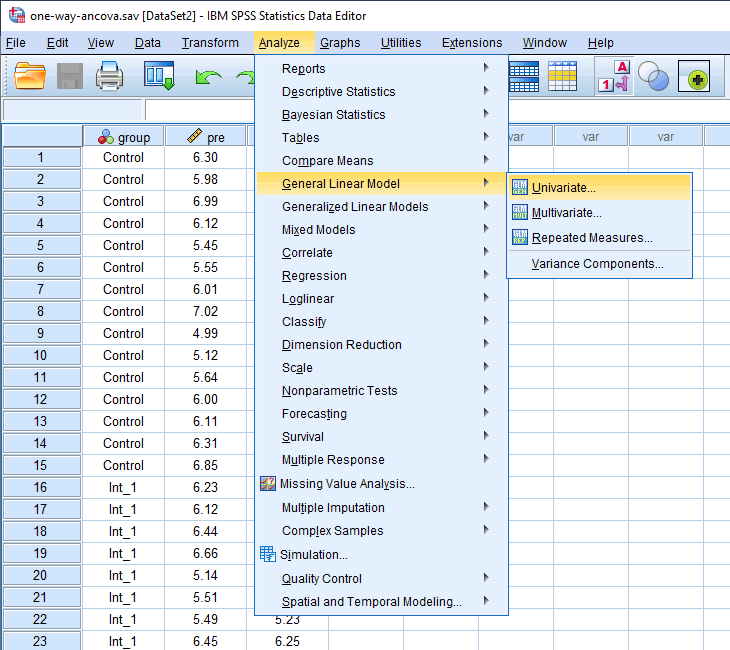
Published with written permission from SPSS Statistics, IBM Corporation.
You volition be presented with the Univariate dialogue box, as shown below:
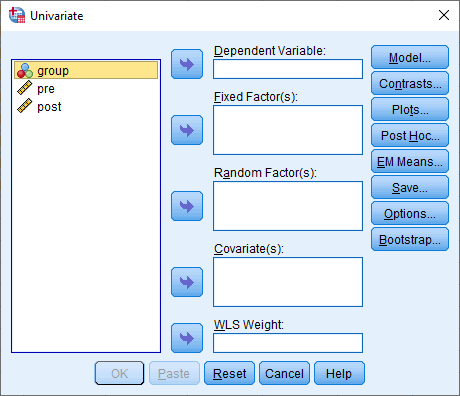
Published with written permission from SPSS Statistics, IBM Corporation.
- Transfer the dependent variable, post, into the Dependent Variable: box, the independent variable, group, into the Fixed Factor(south): box, and the covariate, pre, into the Covariate(south): box, past selecting each variable (by clicking on it) and clicking on the relevant
![right arrow]() button. You will be stop upwards with the screen below:
button. You will be stop upwards with the screen below: 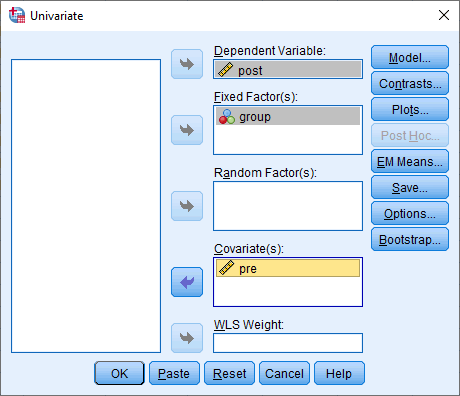
Published with written permission from SPSS Statistics, IBM Corporation.
- Click on the
![EM Means]() button. Y'all volition be presented with the Univariate: Estimated Marginal Means dialogue box, every bit shown beneath:
button. Y'all volition be presented with the Univariate: Estimated Marginal Means dialogue box, every bit shown beneath: 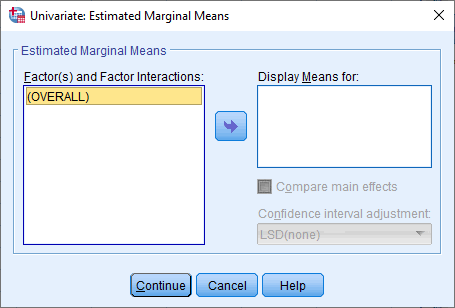
Published with written permission from SPSS Statistics, IBM Corporation.
- Transfer the variable, grouping, from the Fplayer(s) and Cistron Interactions box to the Display Means for: box using the
![right arrow]() push. Then, check Compare main effects, which volition activate the Codue northfidence interval aligning: option. From this drop-down menu, select
push. Then, check Compare main effects, which volition activate the Codue northfidence interval aligning: option. From this drop-down menu, select ![Bonferroni]() from the options, equally shown below:
from the options, equally shown below: 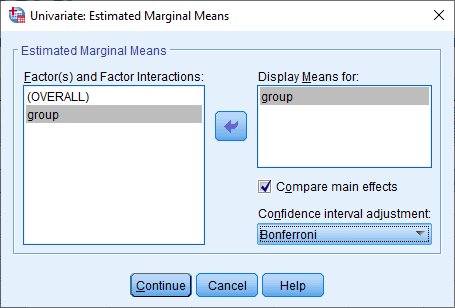
Published with written permission from SPSS Statistics, IBM Corporation.
- Click on the
![Continue]() button and yous will be returned to the Univariate dialogue box.
button and yous will be returned to the Univariate dialogue box. - Click on the
![Options]() button. You volition be presented with the Univariate: Options dialogue box, as shown beneath:
button. You volition be presented with the Univariate: Options dialogue box, as shown beneath: 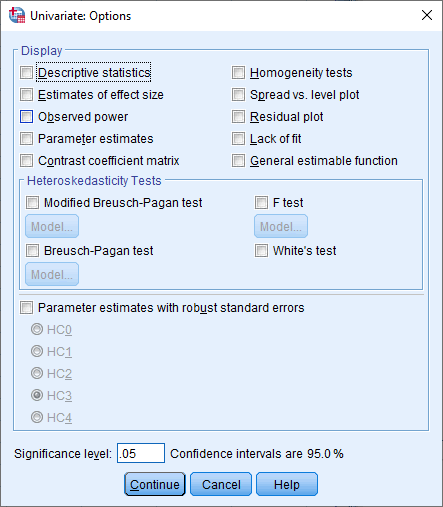
Published with written permission from SPSS Statistics, IBM Corporation.
- Select Descriptive statistics and Eastwardstimates of upshot size in the –Brandish– surface area, every bit shown below:
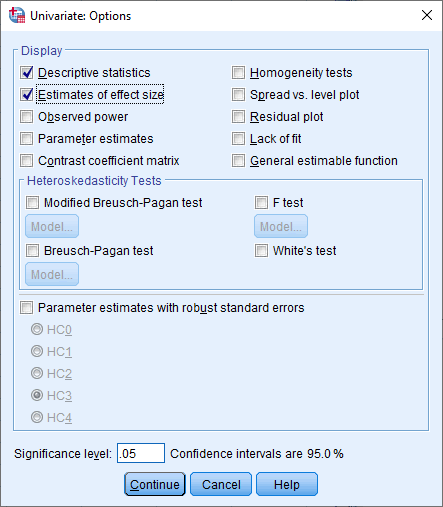
Published with written permission from SPSS Statistics, IBM Corporation.
- Click on the
![Continue]() push button and yous will exist returned to the Univariate dialogue box.
push button and yous will exist returned to the Univariate dialogue box. - Click on the
![OK]() button. This will generate your output.
button. This will generate your output.


 button. You will be stop upwards with the screen below:
 button. Y'all volition be presented with the Univariate: Estimated Marginal Means dialogue box, every bit shown beneath:
 from the options, equally shown below:
 button and yous will be returned to the Univariate dialogue box.
  button. You volition be presented with the Univariate: Options dialogue box, as shown beneath:

 button. This will generate your output.
 Now that you take run the General Linear Model > Univariate... procedure to bear out a 1-way ANCOVA, go to the Interpreting Results section on the adjacent folio. You tin can ignore the section below, which shows yous how to carry out a one-way ANCOVA if yous accept SPSS Statistics version 24 or an earlier version of SPSS Statistics.
SPSS Statistics version 24
and earlier versions of SPSS Statistics
- Click Analyze > General Linear Model > Univariate... on the principal menu, as shown beneath:

Published with written permission from SPSS Statistics, IBM Corporation.
- Y'all will be presented with the Univariate dialogue box, as shown below:
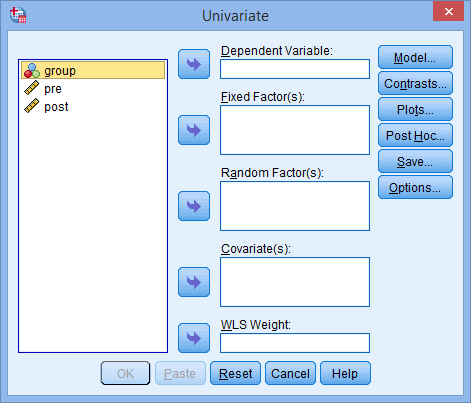
Published with written permission from SPSS Statistics, IBM Corporation.
- Transfer the dependent variable, mail, into the Dependent Variable: box, the contained variable, group, into the Fixed Factor(southward): box, and the covariate, pre, into the Covariate(due south): box, past selecting each variable (by clicking on information technology) and clicking on the relevant
![Right arrow]() button. You will be end upwardly with the screen below:
button. You will be end upwardly with the screen below: 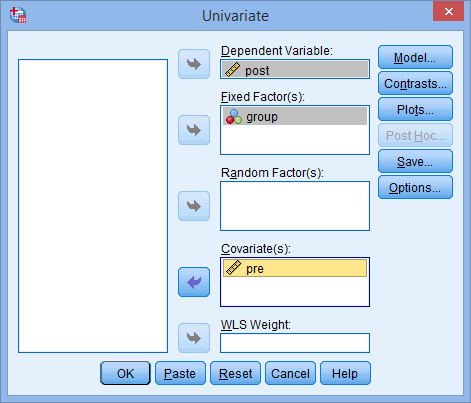
Published with written permission from SPSS Statistics, IBM Corporation.
- Click on the
![Options]() button. You will be presented with the Univariate: Options dialogue box, as shown below:
button. You will be presented with the Univariate: Options dialogue box, as shown below: 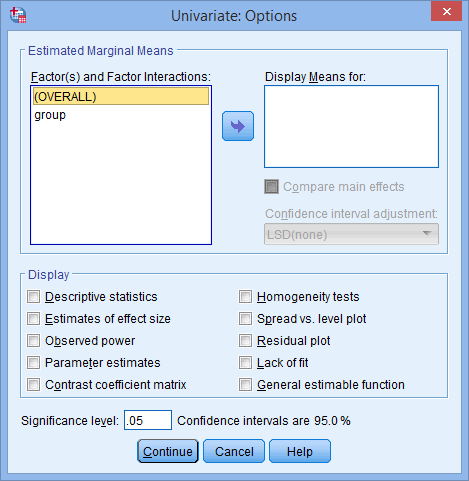
Published with written permission from SPSS Statistics, IBM Corporation.
- Transfer the variable, grouping, from the Factor(southward) and Factor Interactions: box to the Display Keans for: box using the
![Right arrow]() button. Then, bank check Compare master effects, which volition activate the Codue northfidence interval aligning: pick. From this drop-down card, select the
button. Then, bank check Compare master effects, which volition activate the Codue northfidence interval aligning: pick. From this drop-down card, select the ![Bonferroni]() option. Likewise, select Descriptive statistics and Estimates of effect size in the –Display– area, as shown below:
option. Likewise, select Descriptive statistics and Estimates of effect size in the –Display– area, as shown below: 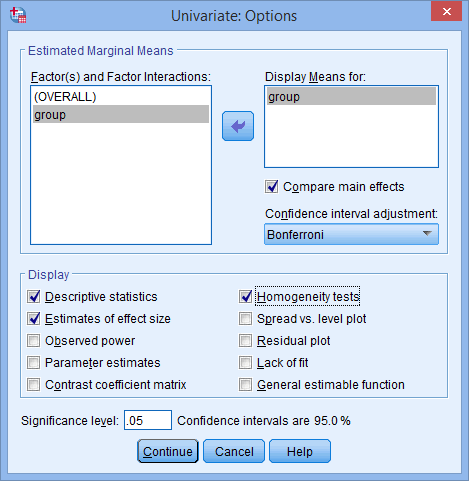
Published with written permission from SPSS Statistics, IBM Corporation.
- Click on the
![Continue]() button and you will be returned to the Univariate dialogue box.
button and you will be returned to the Univariate dialogue box. - Click on the
![OK]() button. This will generate your output.
button. This will generate your output.


 option. Likewise, select
Go to the adjacent page for the SPSS Statistics output and an caption of the output.
Source: https://statistics.laerd.com/spss-tutorials/ancova-using-spss-statistics.php
0 Response to "Reading Results of Univariate Analyses of Covariance"
Postar um comentário